With new data centers being built and expanded across Japan, the grid connection (power supply) application to the utility is increasingly the step that determines the overall project timeline. Because a data center is a demand facility that only receives electricity, both the terminology and the procedural flow differ from those for solar power plants and grid-scale battery storage. Drawing on materials published by TEPCO Power Grid, Chubu Electric Power Grid, and Kansai Transmission and Distribution, this article sets out the flow of a data center power supply application (from the preliminary study through supply approval and the construction cost contribution), how it differs from a battery storage application, and the documents you should have ready. (Abbreviations: TEPCO PG, Chubu PG. Rules and procedures are as of September 2026.)
This article is based on information published as of September 24, 2026. Rules and application forms may be revised, so before proceeding, please also check the latest materials published by the relevant general transmission and distribution operator and other authorities.
A Data Center Grid Connection (Power Supply) Application Is a "Demand-Side" Procedure
The term "grid interconnection" is most often used for the procedure of connecting generation equipment to the power grid, but in the case of a data center it means connecting a "demand facility" that purchases and consumes electricity. TEPCO PG's Wheeling Service Provisions (Article 9) distinguish between the study for connecting generation equipment to the grid, called the "receiving-side connection study" (the generation-side connection study), and the procedure for examining whether construction work is needed to supply a demand facility, called the "supply-side preliminary connection study" (hereinafter the "preliminary study"); the names vary by utility. "Receiving side" and "supply side" are terms from the general transmission and distribution utility's point of view: it receives electricity from power plants and supplies it to demand facilities. A data center application follows the latter, demand-side flow.
The other premise is who submits the application. In Japan, the supply contract for purchasing electricity is concluded with a retail electricity supplier, so the applicant for and party to the wheeling supply contract with the general transmission and distribution utility is the retail electricity supplier. The customer submits the application details through the retail electricity supplier, and because the construction cost contribution is, under the provisions, collected from the retail electricity supplier as the contracting party, the timing and method of payment are agreed between the customer and the retail electricity supplier. The preliminary consultation that precedes the application can be requested directly by the customer or a licensed electrical contractor. In a data center project, the timing of selecting a retail electricity supplier is therefore a prerequisite for the application schedule (see Q1 and Q2 of our Q&A for overseas operators for details).
Demand-side procedures involve no reverse power flow (feeding electricity into the grid) as generation equipment does. Consequently, generation-side rules such as the generation-side connection study (at TEPCO PG, a study fee of JPY 220,000 and a response within three months as a rule) and the submission of documents evidencing land-use rights for the project site do not apply. On the other hand, rules specific to the demand side have been introduced from October 2026 for demand facilities receiving power at extra-high voltage. We cover these in our article on the new rules effective October 1, 2026.
The Data Center Power Supply Application Flow: TEPCO PG as an Example
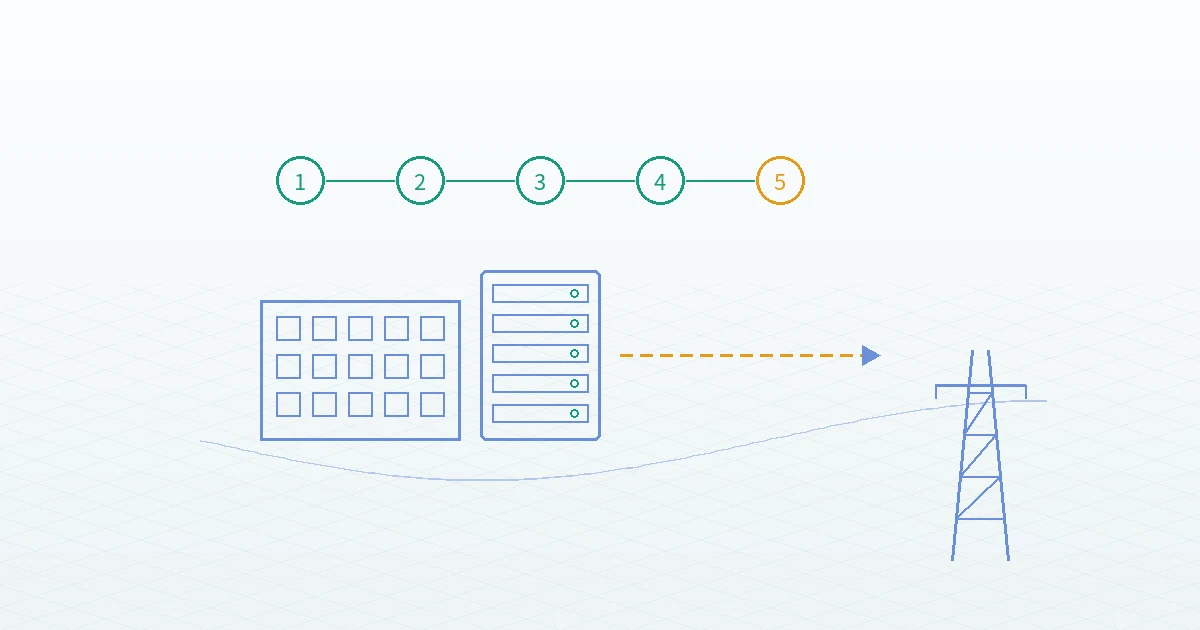
TEPCO PG's "Application flow for new installation, contract changes, and equipment changes for high-voltage / extra-high-voltage supply" presents the demand-side procedure in the following sequence (the descriptions of each step are our own supplementary explanations).
| 1. Preliminary consultation and preliminary study | The "preliminary consultation" (web-based; for contracted power of 50 kW or more), in which the service entrance location and desired supply start date are discussed, is requested by the customer or a licensed electrical contractor. The "preliminary study" (submitted by email on the prescribed form), which confirms whether construction work is required and of what type ahead of the contract application, is requested by the retail electricity supplier or similar party. Although not an obligation under the provisions, TEPCO PG asks for early preliminary consultation for extra-high voltage (66 kV and above), and in practice it is hard to imagine an extra-high-voltage application proceeding without one. |
|---|---|
| 2. Wheeling supply application | The retail electricity supplier contracted by the customer submits the wheeling supply and basic contract application form together with the attachments (a web application system is available; applications cannot be accepted online if the number of days until the desired supply start date is less than the prescribed period). |
| 3. Technical consultation | In general, the specifications of the receiving equipment, protective devices, and similar matters are discussed with the utility. |
| 4. Supply measures study | The utility studies the scope, schedule, and construction cost contribution for the facility work needed to supply the site. |
| 5. Supply approval | The wheeling supply contract is formed when the utility approves the application. |
| 6. Collection of the construction cost contribution | Where utility facilities are newly installed or modified, the construction cost contribution is, as a rule, paid before construction begins. |
| 7. Construction and inspection → 8. Start of wheeling supply → 9. Final settlement | The construction cost contribution is settled after supply begins. |
This flow is broadly the same at the other general transmission and distribution utilities. Chubu PG's "Power Receiving Guidebook for Extra-High-Voltage Customers" (April 2026) states that both the preliminary study preceding the application and the determination of the supply method after the application "normally take 30 business days or more." The response covers whether connection is possible, the supply voltage, an outline of the construction work, the construction cost contribution, the construction period, and operational constraints. Kansai Transmission and Distribution offers a two-stage "supply-side preliminary connection study application": a study that answers whether construction work is required within two weeks as a rule, and a detailed study that provides an outline of the work, the required construction period, and an estimate of the construction cost contribution in around three months.
Note that the desired supply start date appears on utility forms under various names, such as "desired transmission start date" or "desired wheeling supply start date"; in this article we use "desired supply start date" throughout.
How It Differs from a Grid-Scale Battery Storage Application
When a developer with grid-scale battery storage experience takes on a data center, the first source of confusion is the difference in terminology and costs. The main differences are summarized below.
| Name of the study | Battery storage: preliminary inquiry and connection study (receiving side) / Data center: preliminary consultation and preliminary study (supply-side preliminary connection study) |
|---|---|
| Study fee | Battery storage: a study fee is required for the connection study (JPY 220,000 at TEPCO PG) / Data center: the published guidance of TEPCO PG, Chubu PG, and Kansai Transmission and Distribution makes no mention of a study fee for the demand-side preliminary study (although it is not explicitly stated to be free) |
| Response period | Battery storage: connection study within three months as a rule / Data center: Kansai Transmission and Distribution answers whether construction is required within two weeks and completes the detailed study in around three months; Chubu PG normally takes 30 business days or more |
| Cap on number of applications | Battery storage: at TEPCO PG, connection studies for batteries are capped at 11 per applicant / Data center: no comparable cap on the demand side can be found in the published materials |
| Approach to costs | Battery storage: the construction cost contribution for the work needed to connect is paid as a specific (beneficiary-pays) cost / Data center: the construction cost contribution for the work needed to supply the site is paid via the contracting party (the retail electricity supplier). Which costs are treated as specific costs and which as general (socialized) costs varies by project and area |
| Measures against speculative capacity reservation | Battery storage: documents evidencing land-use rights must be submitted within two months after interconnection approval (effective October 1, 2026) / Data center: for extra-high voltage, the construction cost contribution must be paid within three months after supply approval (effective the same day) |
On the demand-side approach to costs, the study group report of the Electricity and Gas Market Surveillance Commission (June 2024) divides cost allocation into "general (socialized) costs," funded from wheeling charges, and "specific (beneficiary-pays) costs," borne by customers and generators, and separately organizes the cost of building the connecting line ("shallow") and the cost of reinforcing the upstream grid ("deep"). Because which costs fall into which category varies by project and area, this is confirmed in the response to the preliminary study. While no charge equivalent to the generation-side connection study fee appears in the published guidance, a point of caution specific to data centers is that construction periods tend to be long at locations where supply-side facility reinforcement is required.
Documents and Information Required for the Application
TEPCO PG's "Overview of applications for extra-high-voltage and high-voltage demand-side customers" (September 2025) lists the following as mandatory documents for a new installation: the wheeling supply and basic contract application form and its annexes, a single-line diagram, a list of receiving equipment, a list of load equipment, a site plan, and a vicinity map. For a new negotiated contract with contracted power of 500 kW or more, supporting documentation for the calculation of contracted power is also mandatory. The fact that a single-line diagram and a list of receiving equipment must be submitted with the application also means that the basic design of the customer's receiving equipment (transformers, circuit breakers, etc.) must be settled before the application is made.
At the preliminary study stage, the main input items are the location of the demand site (address and lot number), the contracted power after the new installation or increase, and the desired supply start date (as in the example of Chubu PG's supply-side preliminary connection study application system). Contracted power (kW) is a value defined under the contract with the utility; it is not the same as the IT load capacity of the servers and other equipment. Confirm the calculation method with the utility and the retail electricity supplier. If you are at the stage of comparing multiple candidate sites, aligning the location and assumed contracted power for each site lets you compare the preliminary study results (whether construction is required, the estimated contribution, and the construction period) on the same basis. If you envisage dual-circuit supply with a main line and a standby line, include the construction cost contribution for the standby line in your estimate as well (TEPCO PG's formula counts the standby line at 20%).
Extra-High Voltage or High Voltage? Supply Voltage Guidelines and the Welcome Zone Map
Under TEPCO PG's Wheeling Service Provisions, the standard voltage is, as a rule, 20,000 V for contracted power of 2,000 kW or more but less than 10,000 kW, and 60,000 V for 10,000 kW or more but less than 50,000 kW. Extra-high voltage refers to a standard voltage of 20,000 V or above. The supply voltage for large-scale projects of 50,000 kW or more must be confirmed with each utility. A data center of several tens of MW will necessarily receive power at extra-high voltage, and the utility-side construction work will be correspondingly large.
The maps published by each utility are useful for a first screening of candidate sites.
| Welcome Zone Map (TEPCO PG) | For: customers with contracted power of 2,000 kW or more seeking extra-high-voltage supply (see the TEPCO PG website for details) |
|---|---|
| Large-Scale Supply Potential Map (TEPCO PG, published November 2025) | For: large-scale extra-high-voltage applications. Classifies the estimated construction period until supply start into 5-year areas and 10-year areas |
| Supply Availability Area Map (Kansai Transmission and Distribution) | For: customers at a standard voltage of 70 kV with contracted power of 10,000 kW or more. Aimed at "customers considering large-scale demand such as data centers (tens to hundreds of MW)," it color-codes indicative available capacity as 10 to under 30 MW, 30 to under 50 MW, and 50 MW or more |
Practical Points to Keep in Mind for Data Center Applications
First, early preliminary consultation. In May 2026, TEPCO PG, citing longer planning and review periods for facility work due to the increase in factory and data center construction, called for early preliminary consultation applications for extra-high-voltage (66 kV and above) work. Second, parallel review of multiple candidate sites. Since the published guidance of the three utilities makes no mention of a fee for the preliminary study, it can be used from the stage of narrowing down candidate sites. Third, the degree to which the application content is settled. Kansai Transmission and Distribution has asked applicants to refrain from wheeling supply applications that are not backed by a genuine business (materials submitted to the study group in March 2024). Furthermore, from October 2026, a payment deadline for the construction cost contribution after supply approval (three months) and cancellation of applications in cases of deficiencies or changes attributable to the customer will be introduced for extra-high-voltage customers.
In addition to grid interconnection applications for grid-scale battery storage and solar power plants, Grid Work supports data center (high-voltage and extra-high-voltage) power supply applications, from screening candidate sites through the preliminary study, preparation of documents for the wheeling supply application via the retail electricity supplier, and consultations with the utility (we are not a party to the wheeling supply contract and do not guarantee the utility's approval, construction period, or construction cost contribution). The battery storage application flow is explained in our article on grid-scale battery storage from connection study to interconnection (Japanese), and the new demand-side rules in our article on supply start dates and application cancellation rules.
Frequently Asked Questions About Data Center Power Supply Applications
Does a data center also need a "connection study"?
If it is a pure demand facility with no co-located generation equipment, the generation-side connection study (receiving-side connection study) does not apply. On the demand side, the flow is preliminary consultation and preliminary study, followed by the wheeling supply application. If generation equipment that operates in parallel with the grid (such as solar or batteries for self-consumption) is co-located, TEPCO PG's application guidance indicates that a grid interconnection application form may be required, and a configuration that feeds power back into the grid requires separate generation-side procedures. Emergency generators that operate disconnected from the grid are normally not subject to this.
How long does the preliminary study take?
At Kansai Transmission and Distribution, the study of whether construction is required takes two weeks or less as a rule and the detailed study around three months; at Chubu PG it normally takes 30 business days or more. TEPCO PG does not state a standard period on its published pages, so this must be confirmed for each project.
Can I apply in any area?
Wheeling supply applications for demand facilities are accepted by general transmission and distribution utilities nationwide. However, because the availability of the facilities needed for supply and the construction period vary greatly by area and location, we recommend checking acceptance status and estimated construction periods with tools such as the Welcome Zone Map and the Large-Scale Supply Potential Map before selecting a candidate site.
How is the construction cost contribution determined?
It is calculated under each utility's Wheeling Service Provisions based on the facility work required for supply. For 66 kV general supply, TEPCO PG has published an approach that multiplies the unit construction cost by the route length of the work subject to the contribution (the transmission line route length) and by the newly added contracted power, then deducts the amount borne by the utility (JPY 5,500 × newly added contracted power). The specific amount is given in the responses to the preliminary study and the supply measures study.
Related Articles and Services
- Data Center Grid Connection Application Support (service overview)
- Data Center Supply Start Dates and Application Cancellation Rules (Effective October 1, 2026): Three-Month Payment Deadline and Siting Conditions
- Q&A: Electricity Procedures for Overseas Operators Developing Data Centers in Japan
- Grid-Scale Battery Storage from Connection Study to Interconnection: Application Flow, Timelines, and Points to Note (Japanese)
- A Practical Guide to Connection Study Applications: Differences from the Preliminary Inquiry, Study Fees, and How to Read the Response (Japanese)
- What Is a Grid Interconnection Application? Flow and Standard Timelines for Low, High, and Extra-High Voltage (Japanese)
- Grid Interconnection Application Consulting (service overview)
References (Primary Sources)
- 高圧・特別高圧供給 新設・契約変更・設備変更に関するお申込みの流れ(東京電力パワーグリッド) (Application flow for new installation, contract changes, and equipment changes for high-voltage / extra-high-voltage supply; TEPCO Power Grid; Japanese)
- 特別高圧・高圧需要側の申込み概要について(東京電力パワーグリッド、2025年9月) (Overview of applications for extra-high-voltage and high-voltage demand-side customers; TEPCO Power Grid, September 2025; Japanese)
- 託送供給等約款(東京電力パワーグリッド) (Wheeling Service Provisions; TEPCO Power Grid; Japanese)
- 大規模供給ポテンシャルマップの公開について(東京電力パワーグリッド、2025年11月20日) (Publication of the Large-Scale Supply Potential Map; TEPCO Power Grid, November 20, 2025; Japanese)
- 特別高圧(66kV以上)工事における早期情報提供のお願い(東京電力パワーグリッド、2026年5月28日) (Request for early information on extra-high-voltage (66 kV and above) construction work; TEPCO Power Grid, May 28, 2026; Japanese)
- 工事費負担金算出の考え方(東京電力パワーグリッド) (Approach to calculating the construction cost contribution; TEPCO Power Grid; Japanese)
- 特別高圧お客さま受電ガイドブック(中部電力パワーグリッド、2026年4月) (Power Receiving Guidebook for Extra-High-Voltage Customers; Chubu Electric Power Grid, April 2026; Japanese)
- 供給側接続事前検討申込(関西電力送配電) (Supply-side preliminary connection study application; Kansai Transmission and Distribution; Japanese)
- 局地的電力需要増加と送配電ネットワークに関する研究会 報告書(電力・ガス取引監視等委員会、2024年6月) (Report of the Study Group on Localized Increases in Electricity Demand and the Transmission and Distribution Network; Electricity and Gas Market Surveillance Commission, June 2024; Japanese)
* The content of this article is current as of its publication date. Later changes to rules or their operation may not be reflected, so please check the official announcements of each organization for the latest information. If you need your project checked against the latest rules, please feel free to contact us.
How does this apply to your project?
Grid connection procedures differ by utility area and facility conditions. Questions at the “what would this mean for our case?” stage are welcome. Our team knows the utility-side process.
Discuss your case