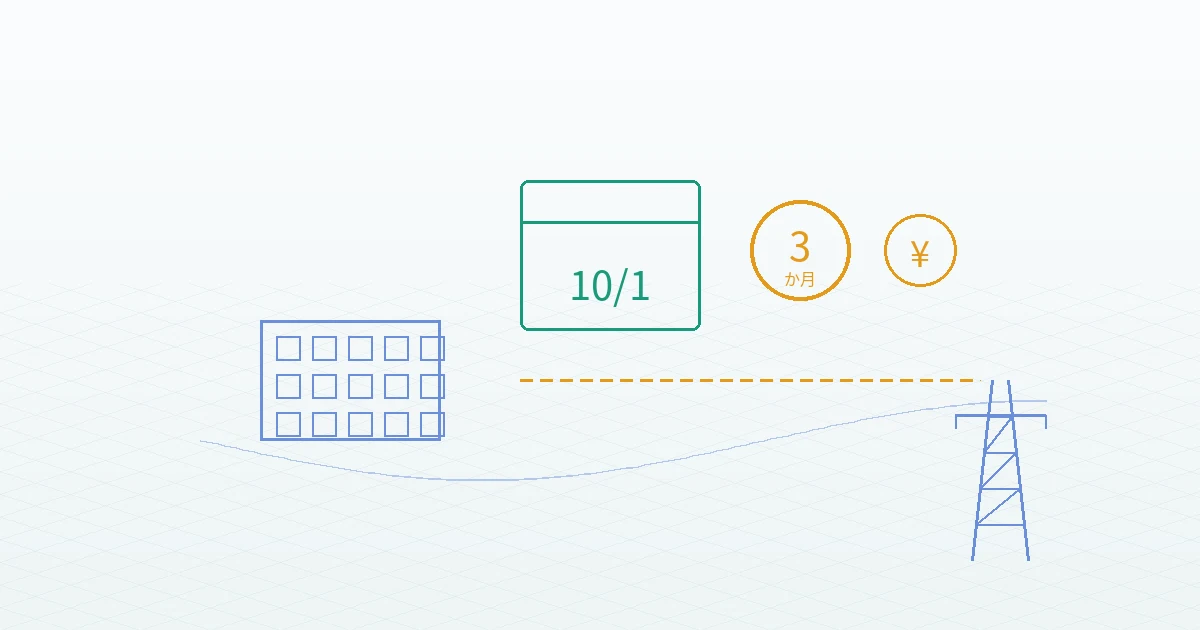
From October 1, 2026, new rules take effect for extra-high-voltage customers: a rule under which the contract application is cancelled if the construction cost contribution is not paid within three months of supply approval, and a rule under which the application is cancelled and must be resubmitted if there are deficiencies or changes attributable to the customer. In addition, from the beginning of FY2027 (April 2027), a mechanism for releasing capacity and settling costs when the start of supply is postponed is under consideration for large-scale demand with a final contracted power of 30 MW or more. Drawing on press releases from the general transmission and distribution utilities and materials from the Agency for Natural Resources and Energy's study group, this article sets out how to think about the supply start date in data center development and the grid-related siting conditions you should keep in mind. (Abbreviations: TEPCO PG, Chubu PG. Rules and procedures are as of September 2026.)
This article is based on information published as of September 29, 2026. Rules and application forms may be revised, so before proceeding, please also check the latest materials published by the relevant general transmission and distribution operator and other authorities.
Background: A Surge in Extra-High-Voltage Demand Applications Makes Speculative Capacity Reservation an Issue
The "Demand Forecast for Japan and Each Supply Area (FY2026)" published by the Organization for Cross-regional Coordination of Transmission Operators (OCCTO) projects that new and expanded data centers and semiconductor plants will add 830,000 kW to peak demand in FY2026, 4,200,000 kW in FY2030, and 7,620,000 kW in FY2035. The increases are especially large in the Hokkaido and Tokyo areas, and demand growth from data centers and semiconductor plants is itemized separately for seven areas, including Tokyo, Chubu, and Kansai.
With demand surging, concern has grown about so-called "speculative capacity reservation," in which grid capacity is held while projects fail to progress. The Agency for Natural Resources and Energy's Next-Generation Power Grid Working Group has been discussing "ensuring discipline for localized large-scale demand" since 2025; the Transmission & Distribution Grid Council publishes the status of extra-high-voltage demand applications (in August 2026, for the position as of the end of June that year); and Kansai Transmission and Distribution has asked applicants to refrain from wheeling supply applications that are not backed by a genuine business (materials submitted to the study group in March 2024).
Effective October 1, 2026: Changes to the Wheeling Service Provisions
The general transmission and distribution utilities, including TEPCO PG, Chubu PG, and Kansai Transmission and Distribution, applied for approval of changes to their Wheeling Service Provisions on June 24, 2026, and received approval on July 22. The effective date is October 1, 2026. There are two changes on the demand side.
| Payment deadline for the construction cost contribution | For extra-high-voltage supply points, the deadline for paying the construction cost contribution is set at three months from supply approval; if the deadline is exceeded, the contract application for that point under the wheeling supply contract is cancelled. |
|---|---|
| Deficiencies in or changes to the application | If deficiencies or changes attributable to the customer arise in the information needed for supply measures work or the technical study, the contract application is cancelled and a new application is required. |
| Scope | Extra-high-voltage customers (per each utility's press release; on the same date, a rule requiring generators to submit documents evidencing land-use rights for the project site within two months of interconnection approval also takes effect on the generation side). |
Materials from the 11th meeting of the Agency for Natural Resources and Energy's Next-Generation Power Grid Working Group (June 10, 2026) set out the following arrangement to accompany this operation: when the general transmission and distribution utility communicates the "earliest date on which electricity supply can begin" as the supply start date in its technical study result, it also issues the notice of supply approval at the same time. Note that because the construction cost contribution is, under the provisions, collected from the party to the wheeling supply contract (the retail electricity supplier), the customer must agree the timing and method of payment with the retail electricity supplier in advance. Although the starting point under the provisions is supply approval, where this operation is adopted the three-month deadline can in practice be considered to start almost simultaneously with the technical study response. Unless the funding plan and internal approval schedule are settled before applying, there is a risk that even after obtaining approval you will be unable to pay within the deadline and will lose the capacity you had secured.
Under Consideration from the Beginning of FY2027: Capacity Release and Cost Settlement for Large-Scale Demand of 30 MW or More
The same 11th meeting materials present, as the next step, measures for postponement of the start of supply and reductions in contracted power. A phased contract here means a contract form in which contracted power is increased in several stages. The key points are as follows.
| Definition of large-scale demand | Customers with a final contracted power of 30 MW or more (a level that would cover roughly the top 10% of extra-high-voltage customers newly connected since FY2020) |
|---|---|
| Measure 1: Capacity release | If the start of supply is postponed or contracted power is reduced partway through a phased contract, the capacity that had been secured is released |
| Measure 2: Cost settlement | If the start of supply for the final contracted power is postponed by more than one year from the plan, the project becomes subject to cost settlement regardless of grid congestion (applies to all areas) |
| Grace period and cap | Postponement is tolerated for one year only. The maximum duration of a phased contract is six years as a rule |
| Grounds for permitted postponement | Limited to cases of clearly verifiable damage, such as disasters |
| Timing of application | Application targeted to start from the beginning of FY2027. Existing customers will be given an opportunity to review their contracted power and other terms themselves |
The specific calculation method for cost settlement was still under consideration at the time of publication of this article, and the finalized content will need to be confirmed in future meeting materials. The direction, however, is clear: "delivering the supply start date and contracted power stated at the time of application as planned" will be a grid-side precondition for data center development going forward.
How to Set the Supply Start Date: Reading the Utility's Construction Timeline
One factor that cannot be overlooked when deciding the supply start date is the time required for the utility's own construction work. TEPCO PG's "Standard construction periods for extra-high-voltage work" (May 2026) gives the following estimates. All are stated to be approximate and not a guarantee of supply within the period.
| Overhead transmission line: new or replacement towers (fewer than 3 towers, approx. 0.7 km) | Approx. 42 months |
|---|---|
| Overhead transmission line: new substation or additional transformer plus new towers | Approx. 120 months |
| Underground transmission line: new substation plus new ducts and cable (approx. 3 km) | Approx. 120 months |
| Underground transmission line: new ducts and cable only | Approx. 96 months |
The company's "Large-Scale Supply Potential Map" likewise divides large-scale extra-high-voltage applications into areas with an estimated construction period of 5 years and areas of 10 years.
By contrast, where power is received at high voltage and only minor reinforcement of distribution facilities is needed, construction periods are much shorter. Kansai Transmission and Distribution gives indicative periods for new or expanded high-voltage supply of around 3 to 5 months for overhead lines and around 3 to 9 months for underground lines (extra-high voltage is negotiated individually for each application). The approach to the supply start date is completely different for an edge data center receiving power at high voltage (under TEPCO PG's provisions, as a rule contracted power below 2,000 kW) and for an extra-high-voltage project of several tens of MW.
It is safest to finalize the supply start date only after receiving the utility's response on its construction period, not solely on the basis of the customer's own construction schedule. Kansai Transmission and Distribution's guidance also explains that the detailed study response is "valid as of the time of the response" and that it is only confirmed by supply approval following the supply study after the contract application. The sequence, then, is to state a desired supply start date with adequate margin on the application form, based on the construction period indicated in the preliminary study, and after approval to ensure payment within three months and manage the schedule rigorously.
Selecting Candidate Sites from a Grid Perspective
Data center site selection weighs many factors, such as telecommunications lines, water sources, and disaster risk, but from a grid perspective the following points bear directly on whether an application succeeds.
Check the published maps
TEPCO PG publishes the Welcome Zone Map for customers with contracted power of 2,000 kW or more seeking extra-high-voltage supply, and the Large-Scale Supply Potential Map, which shows estimated construction periods (5-year areas and 10-year areas) for large-scale extra-high-voltage applications. Kansai Transmission and Distribution publishes the Supply Availability Area Map for customers with contracted power of 10,000 kW or more at a standard voltage of 70 kV, color-coding indicative available capacity as 10 to under 30 MW, 30 to under 50 MW, and 50 MW or more.
Preliminary studies for multiple candidate sites
The published guidance of TEPCO PG, Chubu PG, and Kansai Transmission and Distribution makes no mention of a study fee for the demand-side preliminary study (although it is not explicitly stated to be free), so candidate sites can be studied in parallel and compared on whether construction is required, the estimated contribution, and the construction period. Kansai Transmission and Distribution's request to "refrain from applications not backed by a genuine business" is directed at wheeling supply applications, but in consideration of the utilities' study workload we recommend limiting the candidate sites taken to the preliminary study to locations where the business plan is genuinely feasible.
Fix the location and contracted power
The main input items for the preliminary study are the location of the demand site (address and lot number), the contracted power after the new installation or increase, and the desired supply start date. Ideally, the location of each candidate site should be fixed down to the lot number.
Beyond the grid, factors such as disaster risk (landslide warning zones and the like), designated archaeological sites, distance from neighboring residences, and equipment delivery routes also affect the shortlisting of candidate sites. Please confirm these with specialists in each field in parallel with the grid-side first screening.
Practical Handling of Data Center Power Supply Applications from October 2026
For data center applications from October 2026 onward, preparation before applying determines the outcome. There are three points to cover.
| List the candidate sites | Tabulate the preliminary study results for each candidate site (whether construction is required, estimated contribution, construction period) in a common format |
|---|---|
| Prepare funding and approvals | Before applying, put in place a funding plan and internal approvals that allow the construction cost contribution to be paid within three months of supply approval. The amount of the contribution is given in the responses to the preliminary study and the supply measures study, and for extra-high voltage it varies greatly with the scope of the utility's work |
| Finalize the application content | Finalize the single-line diagram, list of receiving equipment, list of load equipment, and supporting documentation for contracted power, and apply through the retail electricity supplier in a state where no changes attributable to the customer will arise |
When advancing multiple sites in parallel, a mechanism for centrally managing each project's approval date, payment deadline, and desired supply start date becomes essential.
Grid Work supports data center power supply applications from screening candidate sites through the preliminary study, preparation of documents for the wheeling supply application via the retail electricity supplier, and deadline management (we are not a party to the wheeling supply contract and do not guarantee the utility's approval, construction period, or construction cost contribution). The overall flow of the power supply application is explained in our article on the data center grid connection (power supply) application flow.
Frequently Asked Questions About the New Rules for Large-Scale Demand
Do the new rules effective October 1 also apply to high-voltage data centers?
According to each utility's press release, the three-month payment deadline for the construction cost contribution and the cancellation rule apply to "extra-high-voltage customers." Projects receiving power at high voltage were not covered at the time of publication of this article, but please confirm against the latest provisions.
What happens to projects that have already received supply approval?
The payment deadline rule takes effect on October 1, 2026. Please confirm how it applies to existing projects in each general transmission and distribution utility's provisions and guidance. Regarding the cost settlement under consideration for the beginning of FY2027, the stated policy is to give existing customers an opportunity to review their contracted power and other terms themselves.
Can the supply start date be pushed back?
Under the current proposals, postponement of the final contracted power would be tolerated for one year only, with any postponement beyond that subject to cost settlement. Except for clearly verifiable grounds such as disasters, postponement attributable to the customer may result in cost liability.
Does the preliminary study result secure capacity?
No. The responses to the preliminary study and the detailed study reflect information as of the time of the response; capacity is confirmed only when supply approval is received following the supply study after the contract application.
Related Articles and Services
- Data Center Grid Connection Application Support (service overview)
- The Data Center Grid Connection (Power Supply) Application Flow: Differences from Battery Storage, from Preliminary Study to Supply Approval
- Q&A: Electricity Procedures for Overseas Operators Developing Data Centers in Japan
- Land-Use Rights Documents Become Mandatory from October 1, 2026: Within Two Months of Interconnection Approval, and a Summary of Anti-Speculation Measures (Japanese)
- Mid-Period Revision of Wheeling Charges (Effective November 1, 2026) and the New Generator-Side Wheeling Charge Rates: Impact on Battery Storage (Japanese)
- Grid Interconnection Application Consulting (service overview)
References (Primary Sources)
- 託送供給等約款の認可について(東京電力パワーグリッド、2026年7月22日) (Approval of the Wheeling Service Provisions; TEPCO Power Grid, July 22, 2026; Japanese)
- 託送供給等約款の変更認可申請について(東京電力パワーグリッド、2026年6月24日) (Application for approval of changes to the Wheeling Service Provisions; TEPCO Power Grid, June 24, 2026; Japanese)
- 託送供給等約款の認可について(関西電力送配電、2026年7月22日) (Approval of the Wheeling Service Provisions; Kansai Transmission and Distribution, July 22, 2026; Japanese)
- 託送供給等約款の変更認可について(中部電力パワーグリッド) (Approval of changes to the Wheeling Service Provisions; Chubu Electric Power Grid; Japanese)
- 局地的な大規模需要に対する規律確保について(資源エネルギー庁 第11回次世代電力系統ワーキンググループ 資料1、2026年6月10日) (Ensuring discipline for localized large-scale demand; Agency for Natural Resources and Energy, 11th Next-Generation Power Grid Working Group, Document 1, June 10, 2026; Japanese)
- 全国及び供給区域ごとの需要想定(2026年度)(電力広域的運営推進機関、2026年1月) (Demand Forecast for Japan and Each Supply Area (FY2026); Organization for Cross-regional Coordination of Transmission Operators, January 2026; Japanese)
- 特別高圧需要の申込状況の公表について(送配電網協議会、2026年8月24日) (Publication of the status of extra-high-voltage demand applications; Transmission & Distribution Grid Council, August 24, 2026; Japanese)
- 特別高圧工事の標準的な所要工期(東京電力パワーグリッド、2026年5月) (Standard construction periods for extra-high-voltage work; TEPCO Power Grid, May 2026; Japanese)
- 供給工事の実施(関西電力送配電) (Carrying out supply construction work; Kansai Transmission and Distribution; Japanese)
- 供給可能エリアマップ(関西電力送配電) (Supply Availability Area Map; Kansai Transmission and Distribution; Japanese)
- ウェルカムゾーンマップ(東京電力パワーグリッド) (Welcome Zone Map; TEPCO Power Grid; Japanese)
* The content of this article is current as of its publication date. Later changes to rules or their operation may not be reflected, so please check the official announcements of each organization for the latest information. If you need your project checked against the latest rules, please feel free to contact us.
How does this apply to your project?
Grid connection procedures differ by utility area and facility conditions. Questions at the “what would this mean for our case?” stage are welcome. Our team knows the utility-side process.
Discuss your case